
Listen> https://youtu.be/cm96Eg-c7us?si=lV7zwHFhp0aaAcsq
Bakhita Stand Your Ground
They took her from the sun,
A girl lost in the desert haze,
Dragged through markets, beaten down,
Yet still she held a hidden blaze.
Bakhita, stand your ground,
Let your courage shape the sound,
From the cruelty of the past,
To the freedom you had found.
Bakhita, stand your ground,
Lift your voice above the scar,
From the darkness of the world,
To the light that called you far.
Italy opened doors,
A place where she could breathe again,
Learning faith with steady steps,
A quiet strength that would not bend.
Bakhita, stand your ground,
Let your courage shape the sound,
From the cruelty of the past,
To the freedom you had found.
Bakhita, stand your ground,
Lift your voice above the scar,
From the darkness of the world,
To the light that called you far.
She turned her pain to truth,
A witness born from broken years,
Teaching hearts that mercy grows,
Where courage overcomes the fears.
Bakhita, stand your ground,
Let your courage shape the sound,
From the cruelty of the past,
To the freedom you had found.
Bakhita, stand your ground,
Lift your voice above the scar,
From the darkness of the world,
To the light that called you far.
Her story travels still,
A path from suffering to grace,
A woman who survived the storm,
And lifted others in her place.
STORY BOARD
SONG OVERVIEW
Written and produced by Tasmanian Songwriter Jason Bresnehan, Bakhita Stand Your Ground is a musical arrangement in the Afro-Pop genre with a female vocal. Inspired by the life of Saint Josephine Bakhita, the song tells the story of a woman who survived slavery, cruelty and displacement before finding freedom, faith and purpose. The song celebrates resilience rather than suffering, focusing on the extraordinary strength that carried Bakhita from captivity to a life that continues to inspire people around the world.
Within the Saints and Sinners project, Bakhita's story is one of the most dramatic movements from darkness into light. Her saintly journey was neither comfortable nor predictable. Everything that happened to her should have diminished her spirit. Instead, she emerged as a witness to human dignity, forgiveness and faith. The repeated chorus built around the hero line "Bakhita, stand your ground" transforms her story into a declaration of perseverance.
FROM CAPTIVITY TO FREEDOM
Josephine Bakhita's life began in circumstances that were violently interrupted by slavery. Taken from her family as a child and subjected to years of exploitation and cruelty, she experienced suffering on a scale difficult for most modern listeners to imagine.
The opening verse establishes this reality through images of deserts, markets and hardship. Yet the song deliberately introduces another image alongside the suffering. Even in the midst of that darkness, Bakhita carried a "hidden blaze". The lyric presents her dignity as something that survived every attempt to extinguish it.
The story then moves to Italy, where freedom finally became possible. The second verse captures a quieter form of transformation. Rather than dramatic liberation, Bakhita's future unfolded through faith, stability and a growing sense of purpose. The song recognises that true freedom is more than the removal of chains. It is the discovery of a life worth living.
STAND YOUR GROUND
The central phrase of the song carries several layers of meaning. At the most direct level it describes resilience. Bakhita survived experiences that would crush many people and refused to surrender her humanity.
At a deeper level it represents personal dignity. Throughout her life other people attempted to define her value. The song rejects those definitions completely. Her worth was never determined by her circumstances. The phrase also speaks to faith. When Bakhita eventually embraced Christianity, she found a foundation stronger than fear, suffering or the judgments of others. Standing her ground became an act of spiritual strength as much as personal courage.
Each repetition of:
"Bakhita, stand your ground"
therefore becomes a declaration of identity, dignity and purpose.
THE POWER OF FORGIVENESS
One of the most remarkable aspects of Josephine Bakhita's life is that she became known not only for surviving suffering but for refusing to become defined by bitterness. Many people can understand survival. Forgiveness is often much harder to understand.
The bridge addresses this directly:
"She turned her pain to truth,
A witness born from broken years."
The song presents Bakhita's greatest achievement as the transformation of suffering into service. Her experiences enabled her to speak with authenticity about mercy, compassion and hope. Rather than allowing her past to control her future, she used it to help others.
This movement from pain to purpose sits at the heart of the song.
COURAGE THAT SPEAKS TO TODAY
Although rooted in the life of a nineteenth-century saint, the themes of Bakhita Stand Your Ground are profoundly contemporary. The song speaks to anyone who has experienced hardship, discrimination, addiction, abuse, loss or circumstances that threaten to define their future. Bakhita's story demonstrates that a person's identity is larger than the worst thing that has happened to them. Her life reminds listeners that resilience is not simply enduring suffering. Resilience is continuing to move forward while refusing to surrender hope. The song therefore functions as both a tribute to a saint and an encouragement to anyone facing their own difficult journey.
THE ARTWORK
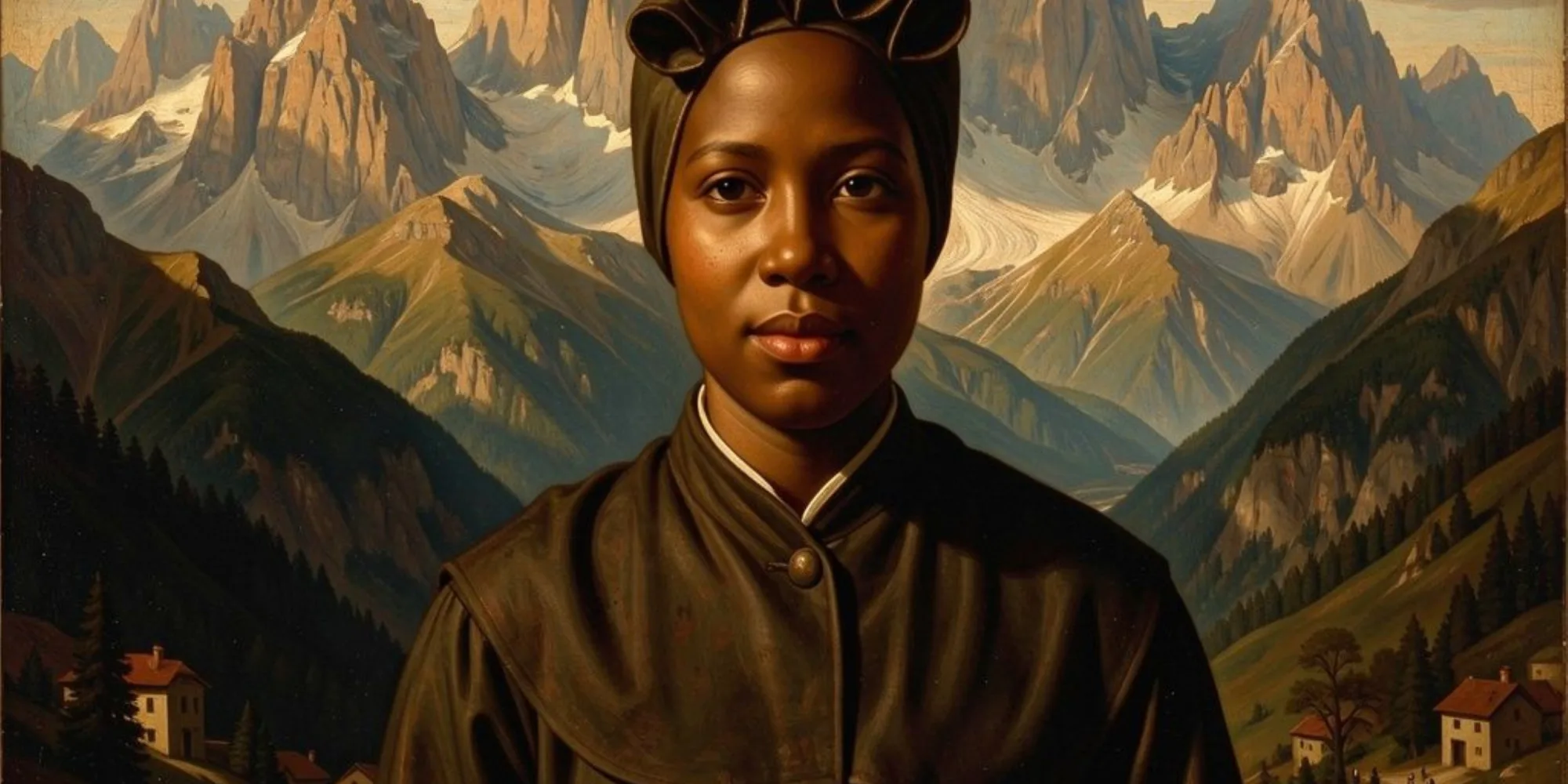
The artwork presents Josephine Bakhita standing prominently in the foreground against a dramatic mountain landscape bathed in warm golden light. Positioned at the centre of the composition, Bakhita immediately becomes the focal point of the image. Her calm presence contrasts with the immense mountain ranges behind her, creating a visual statement of quiet strength.
The mountains serve as a powerful symbol of adversity, endurance and perseverance. In the context of Bakhita's life they can be understood as representing the immense challenges she overcame throughout her journey from slavery to freedom. Yet the mountains do not overwhelm her. Instead, they frame her, reinforcing the song's central message that courage can stand firm against enormous obstacles.
The warm lighting contributes significantly to the image's emotional impact. Golden light spreads across the valleys and peaks, creating an atmosphere of hope, renewal and purpose. Small villages and pathways visible in the landscape suggest community, belonging and a future that extends beyond suffering.
The overall effect is one of dignity rather than triumphalism. The artwork does not depict conflict or victimhood. It depicts a woman who has already passed through hardship and emerged with her humanity intact. It perfectly complements the song's message that strength is often expressed through steadfastness rather than force.
PERSONAL CONNECTION TO JASON BRESNEHAN SONGWRITER AND PRODUCER
Josephine Bakhita's story resonates strongly with one of the recurring themes throughout Jason Bresnehan's songwriting: a person's future does not need to be determined by their past.
Many songs within the Saints and Sinners project explore people who faced extraordinary setbacks, suffering or brokenness before discovering a deeper purpose. Bakhita's life provides one of the most striking examples of this transformation. Her early experiences provided every reason for despair, yet she ultimately became a symbol of faith, dignity and forgiveness.
Her story also aligns with Jason's ongoing interest in recovery, resilience and renewal. While Bakhita's experiences were vastly different from those encountered in recovery communities, both journeys share a common principle. Human beings are capable of becoming far more than the circumstances that once defined them.
For Jason, Bakhita's witness offers a reminder that true courage often appears in quiet forms. It is found in the ability to continue moving forward, to maintain dignity under pressure and to choose hope when bitterness would appear easier.
Bakhita Stand Your Ground therefore becomes more than a song about a saint. It becomes a declaration that human worth survives suffering, that freedom can emerge from captivity, and that courage can carry a person far beyond the hardships of their past.