
Listen> https://youtu.be/XTVJwooA1Z4?si=oXoxVGbG9SQYTzmD
Forged in Fire
He was ore in the earth, restless and unrefined,
Chasing wisdom, pleasure and every kind of mind.
A life of reactions and fractures that couldn’t stay still,
Tilted seams of red ocher rocks forming on every hill.
Ore ran wild till the fire ran deep,
Grace hit hard and the shape went steep.
Hot heart dropped and the steel came through,
Conviction forged as God’s call grew.
Heat rose around his thinking, burning off the old design,
Roman talkers lit the fire and Plato’s mystics bent the line.
He knew the truth was calling, but he couldn’t make the turn,
Metal glowing in the furnace, too hot to hold, too cold to burn.
Ore ran wild till the fire ran deep,
Grace hit hard and the shape went steep.
Hot heart dropped and the steel came through,
Conviction forged as God’s call grew.
A child’s garden song sent a message through the air,
He opened the Bible and God’s lessons were waiting there.
Augustine plunged his burning heart into a pure watery lake,
His conviction forged in steel with the cleanse he had to take.
Every life starts scattered like ore in the ground,
Every heart hits fire till the shape breaks down.
But grace still waits where the scarred souls kneel,
And every restless wanderer can be forged to steel.
Ore ran wild till the fire ran deep,
Grace hit hard and the shape went steep.
Hot heart dropped and the steel came through,
Conviction forged as God’s call grew.
STORY BOARD
SONG OVERVIEW
Written and produced by Tasmanian Songwriter Jason Bresnehan, Forged in Fire tells the story of St Augustine's transformation from a restless seeker into one of Christianity's most influential thinkers. Rather than presenting Augustine as a saint from the beginning, the song starts with a man who spent years searching for truth, pleasure, knowledge and meaning in all the wrong places. The central metaphor is simple and powerful. Augustine begins as scattered iron ore buried in the earth. Through struggle, conviction, grace and faith, that ore is ultimately forged into steel.
The song is not simply a biography. It takes Augustine's journey and turns it into a story about every person who has wrestled with purpose, identity and belief. The message is that transformation is possible, but transformation rarely happens without heat, pressure and change.
FROM ORE TO STEEL
The image of ore becoming steel sits at the heart of the song. Raw ore contains potential but lacks shape, purpose and strength. It must pass through fire before it becomes something useful.
The lyric uses this process to describe Augustine's early life. He moved through competing philosophies, intellectual pursuits and personal desires while searching for answers. The fire in the song is not punishment. The fire is refinement. Each experience, mistake and struggle becomes part of the process that shapes him into the man he would eventually become.
By the final chorus, the steel represents conviction. Augustine has found a foundation strong enough to build his life upon.
AUGUSTINE'S TURNING POINT
One of the most famous moments in Christian history appears in the third verse. Augustine hears a child's voice singing nearby, urging him to read. That simple moment leads him to open the Bible and encounter the message that transforms his life.
The song captures this event as the final stage of the forging process. Years of searching suddenly find direction. The restless wandering gives way to clarity. What had been scattered finally becomes focused.
The power of the moment is its simplicity. The event itself is small, but the consequences change the course of Augustine's life and influence Christianity for centuries to come.
MUSICAL DIRECTION
Forged in Fire is a guitar-driven country rock song built around strong riffs, solid drums and a confident male vocal performance. The arrangement mirrors the imagery within the lyric, combining weight, movement and momentum to create a sense of constant forward motion.
The verses carry the story while the chorus delivers the central transformation from ore to steel. The music develops naturally as the story progresses, giving the listener the feeling of being carried through Augustine's journey rather than simply observing it from a distance. The result is an energetic rock track that balances storytelling with driving musical power.
THE ARTWORK
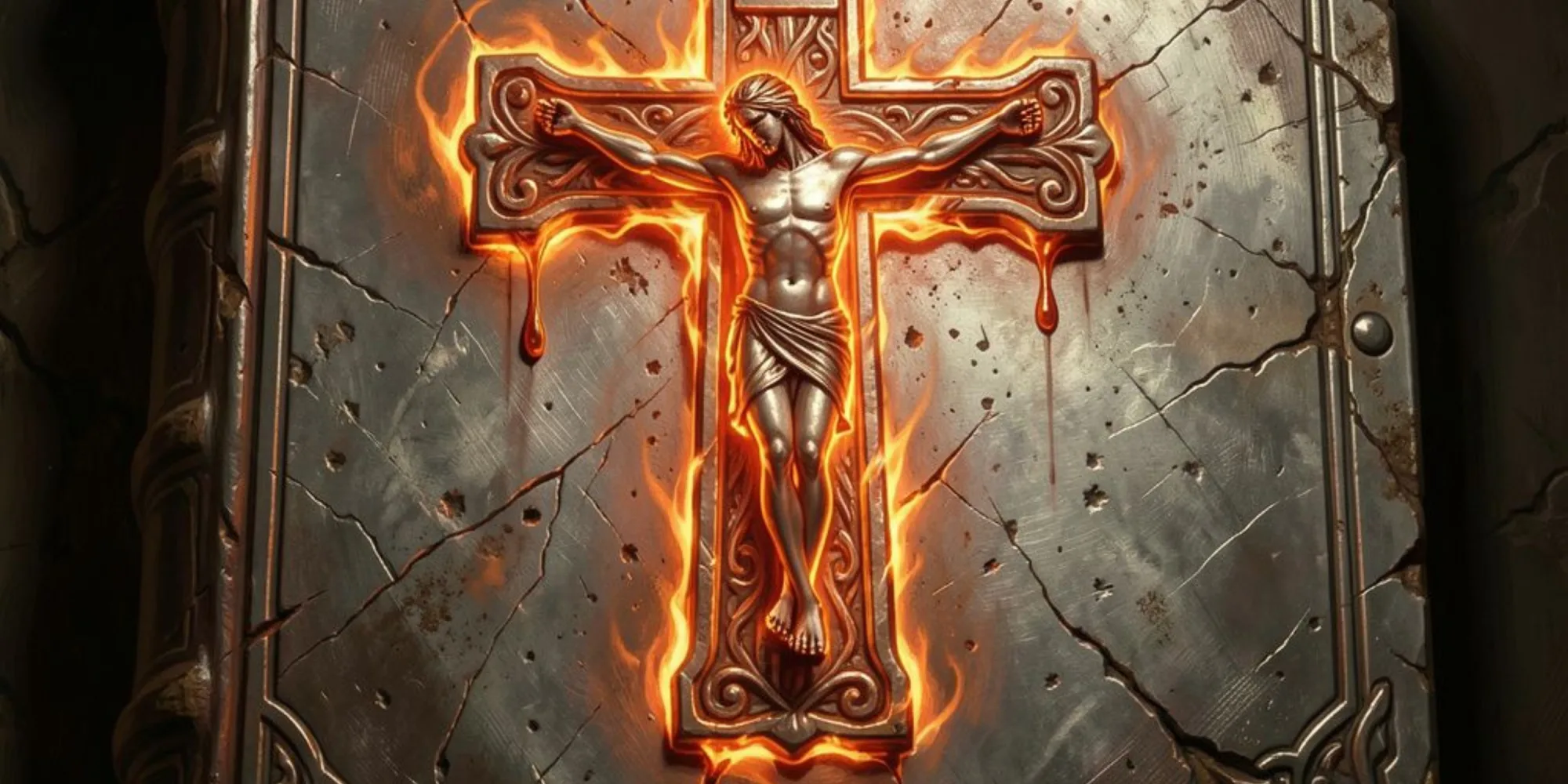
The artwork presents a Bible forged from steel, its cover dominated by a crucifix that appears to have been stamped directly into the metal while still glowing red-hot from the forge. Cracks and stress lines run across the surface, while intense orange light radiates from within the crucifix itself. The image feels less like a book sitting on a shelf and more like a piece of metal still undergoing transformation.
The artwork directly reflects the central metaphor of Forged in Fire. Augustine begins life as scattered ore, full of potential but lacking shape and direction. Through years of searching, learning, questioning and struggle, heat is applied to the metal. The intellectual battles represented by philosophy, rhetoric and competing worldviews become part of the forging process.
The Bible represents the moment when the process reaches its decisive stage. Augustine's encounter with Scripture provides the mould into which the heated metal can finally be formed. The crucifix is shown glowing because the work of transformation is still occurring. The steel has not yet been left to cool. God is still shaping the material.
Most importantly, the artwork reflects the final step in the forging process. Metal is heated, hammered and shaped, but it achieves its final properties through quenching. Within the symbolism of the song, God's grace becomes the quenching process. The scattered ore has already experienced the furnace of life and the shaping forces of knowledge and experience. The encounter with God completes the transformation. What emerges is not scattered ore or heated metal, but steel.
The image therefore captures Augustine at the exact point where conviction is being formed. The glowing crucifix, the forged steel Bible and the intense heat all work together to illustrate the song's core message: God takes the raw materials of a restless life and forges them into something strong, purposeful and enduring.
PERSONAL CONNECTION TO JASON BRESNEHAN SONGWRITER AND PRODUCER
The personal connection to Forged in Fire lies in the parallels Jason sees between Augustine's journey and aspects of his own life. While the circumstances differ, the theme of moving from scattered searching towards conviction is familiar.
Augustine spent years pursuing different ideas, philosophies and answers before finding a foundation that brought clarity to his life. Jason recognises that same pattern in his own journey through recovery, faith and personal transformation. Augustine experienced the famous moment in the garden when a child's voice prompted him to open Scripture. Jason experienced his own decisive turning point at the lowest point of alcoholism, what he describes as a "gates of hell" moment, where continuing on the same path was no longer an option.
Those moments are different in form but similar in outcome. Both represent a point where direction changes and conviction begins to form. That connection is what gives Forged in Fire its personal significance. The song celebrates Augustine's story while also reflecting a broader truth: people can begin scattered like ore in the ground yet emerge stronger, clearer and more purposeful after passing through the fire.
This song is also part of the 27-song series for my first TSB (Themed Song Book) called Saints and Sinners.
Augustine of Hippo was born on 13 November 354 in Thagaste, in present-day Algeria, and died on 28 August 430 in Hippo Regius. His saintly movement took place across North Africa and Italy, where his search for truth led him from worldly ambition to Christian faith. He became Bishop of Hippo and one of the most influential thinkers in Church history. His resting place is recognised at the Basilica of San Pietro in Ciel d'Oro in Pavia, Italy.
Augustine spent much of his early life pursuing success, learning and personal ambition, yet he remained restless and dissatisfied. His conversion to Christianity changed the direction of his life and led to decades of teaching, writing and service. Augustine’s movement shows that many people spend years searching for purpose before finding it. His saintly movement carried him from restlessness to conviction, leaving a legacy that continues to influence Christians throughout the world.