
Listen on YouTube Music > https://www.youtube.com/watch?v=rKuiseaRJLg
Holdin' Fast
Whispers of the night, where shadows creep slow
In a land filled with troubles, I walk where sorrows flow
Ma’s at rest in heaven’s endless store,
Me Pa is locked behind the jailers’ doors,
The father of my little ones is tryin’ hard to feed us all,
I’m prayin’ God’s own eyes will halt my brothers’ fall.
Each breath a heavy burden, the air thick with fate,
In a world darkly woven, we bear what we hate.
Wayward men stitchin’ evil in my soul,
At war with tax‑men on patrol,
I’m holdin’ fast as burdens toll,
Wayward men stitchin’ evil in my soul.
The little ones I’m turnin’ out to school each morn,
All the men out smugglin’ on the shore,
And whisky stills hid deep where the bracken’s worn,
Tax‑men prowin’ lanes where revenge is sworn.
Take your boots, and wash up ‘fore you eat,
Your hush‑talk deeds come trailin’ in with sleet,
And grace is yours tonight for wrongs you chose to meet,
Confessin’ come the morn when priest and penance greet.
Wayward men stitchin’ evil in my soul,
At war with tax‑men on patrol,
I’m holdin’ fast as burdens toll,
Wayward men stitchin’ evil in my soul.
Take your boots and leave ’em by the door,
Cold lantern light still clingin’ from the moor,
Your deeds come trailin’ in across my cottage floor,
And I’ll not have sin crossin’ here no more.
Word comes whisperin’ down the lane of somethin’ sore,
Redcoats ridin’ hard and askin’ at each door,
And if they take you, you’ll be sittin’ where me Pa sits once more,
I feel the darkness stir — stitchin’ evil in my core.
Wayward men stitchin’ evil in my soul,
At war with tax‑men on patrol,
I’m holdin’ fast as burdens toll,
Wayward men stitchin’ evil in my soul.
In the shadows of the moor, where hope struggles to rise,
I’ll carry these burdens beneath silent skies,
As I tread this path, where sorrows uncoil,
Each step, each breath, “Am I lost in the toil?”
STORY BOARD
SONG OVERVIEW
Written by Tasmanian Songwriter Jason Bresnehan, Holdin' Fast is an Irish folk ballad set in rural County Tipperary in the 1840s. Told from the perspective of a young wife and mother trying to hold her family together, the song explores faith, poverty, danger, smuggling, family burden and moral exhaustion in a world where survival and wrongdoing often sit uncomfortably close together. Inspired by Jason’s Irish ancestry and direct descent from John Bresnehan of Limerick, an Irish convict transported to Van Diemen’s Land, the song gives voice not to the outlaw, rebel or smuggler, but to the woman left at home carrying the consequences.
THE SCENE
The song unfolds inside and around a modest Irish cottage during a difficult period in rural Tipperary. Outside the home are moors, lanes, smugglers, hidden whiskey stills, tax-men, redcoats and whispered danger. Inside the home are children, food, prayer, firelight and the daily effort required to keep a family alive. The contrast between the cottage and the outside world is central to the song. The home represents order, faith and survival, while the world beyond the door carries secrecy, risk, violence and consequence.
THE NARRATOR
The narrator is a young wife and mother carrying more than one person should have to carry. Her mother is dead, her father is imprisoned and the men around her are drawn into dangerous activities that threaten to repeat the same cycle of arrest, shame and family suffering. She is not naïve. She understands why desperate people make desperate choices, but she also understands the spiritual and human cost of those choices. Her voice carries frustration, love, fear, faith and exhaustion in equal measure.
PURPOSE
The purpose of Holdin' Fast is to explore the unseen burden carried by those left behind when others choose dangerous paths. Irish songs often give attention to rebels, smugglers, drinkers, fighters and men standing against authority. This song turns the camera towards the person at home, the one feeding children, watching the road, listening for rumours and praying that the men she loves do not end up behind the same doors as her father. The song asks what survival costs when poverty, family loyalty and moral compromise become entangled.
IDENTITY
The identity theme centres on endurance. The narrator is surrounded by people whose identities are shaped by risk, defiance and secrecy. Her identity is formed through responsibility. She is the one holding the household together, protecting the children, insisting on prayer, drawing boundaries at the door and trying to keep sin from becoming normal inside her home. She is not powerful in any public sense, but she is the moral centre of the song. Her strength is quiet, practical and deeply rooted in faith.
MOVEMENT
Movement is expressed through pressure. The song begins with grief and burden, then moves through domestic responsibility, confrontation, warning and spiritual exhaustion. Each verse adds another layer of strain: children needing care, men involved in smuggling, hidden stills, tax-men on patrol, redcoats asking questions and the fear that history will repeat itself. The narrator does not escape her situation, but she refuses to collapse beneath it. The movement is not toward victory. It is toward endurance.
MUSICAL DIRECTION
Holdin' Fast was written as a traditional Irish folk ballad with a dark, intimate atmosphere. The arrangement should centre on acoustic instruments, restrained percussion, fiddle, whistle or low strings, and a vocal delivery that feels lived-in rather than polished. The song should not feel like a pub celebration. It should feel like something sung beside a fire after a hard day, when the room is quiet and the truth can no longer be avoided. The music should carry the weight of history, poverty, prayer and family burden.
THE WOMAN'S PERSPECTIVE
One of the defining features of the song is its perspective. The narrator is not glorifying smuggling, rebellion or outlaw behaviour. She is living with the consequences of those choices. The men may see themselves as fighting tax-men, surviving poverty or doing what must be done, but the narrator sees the boots at the door, the whispered lies, the danger brought into the cottage and the children watching it all unfold. Her perspective gives the song its emotional force because she loves the people involved while also recognising the damage they bring home.
FAMILY BURDEN
Family burden sits at the heart of the song. The narrator’s mother is gone, her father is imprisoned and she fears the same fate may fall upon the next generation of men around her. The repeated references to jailers, redcoats, tax-men and whispered danger create the sense of a family trapped inside a pattern. The narrator is not only afraid of one arrest or one bad night. She is afraid of inherited ruin, where the mistakes of one generation become the inheritance of the next.
FAITH AND MORALITY
Faith is one of the narrator’s few remaining anchors. She prays, speaks of grace, references confession and penance, and measures the conduct around her against a spiritual standard that has not yet collapsed. The song does not present the narrator as self-righteous. She knows life is hard and she knows hunger can push people towards compromise. But she also knows that survival without moral boundary becomes another kind of prison. Her faith gives her language for grief, judgement, mercy and endurance.
THE COTTAGE
The cottage is the emotional centre of the song. It is where food is prepared, children are raised, prayers are said and boundaries are drawn. The repeated instruction to take boots off and leave them by the door is more than domestic discipline. It is a demand that the outside world, with its mud, secrecy and sin, does not get to claim the inside of the home. The cottage becomes a small fortress of order against a world that keeps trying to drag disorder across the threshold.
THE TAX-MEN AND REDCOATS
The tax-men and redcoats represent authority, consequence and the constant threat of exposure. To the men involved in smuggling or illegal whiskey production, these figures are enemies. To the narrator, the matter is more complicated. She understands the resentment, but she also sees the danger. Every act of defiance risks another arrest, another family wound and another child growing up beneath the shadow of shame. The song refuses to make the conflict simple because the people living through it could not afford simplicity.
THE ARTWORK
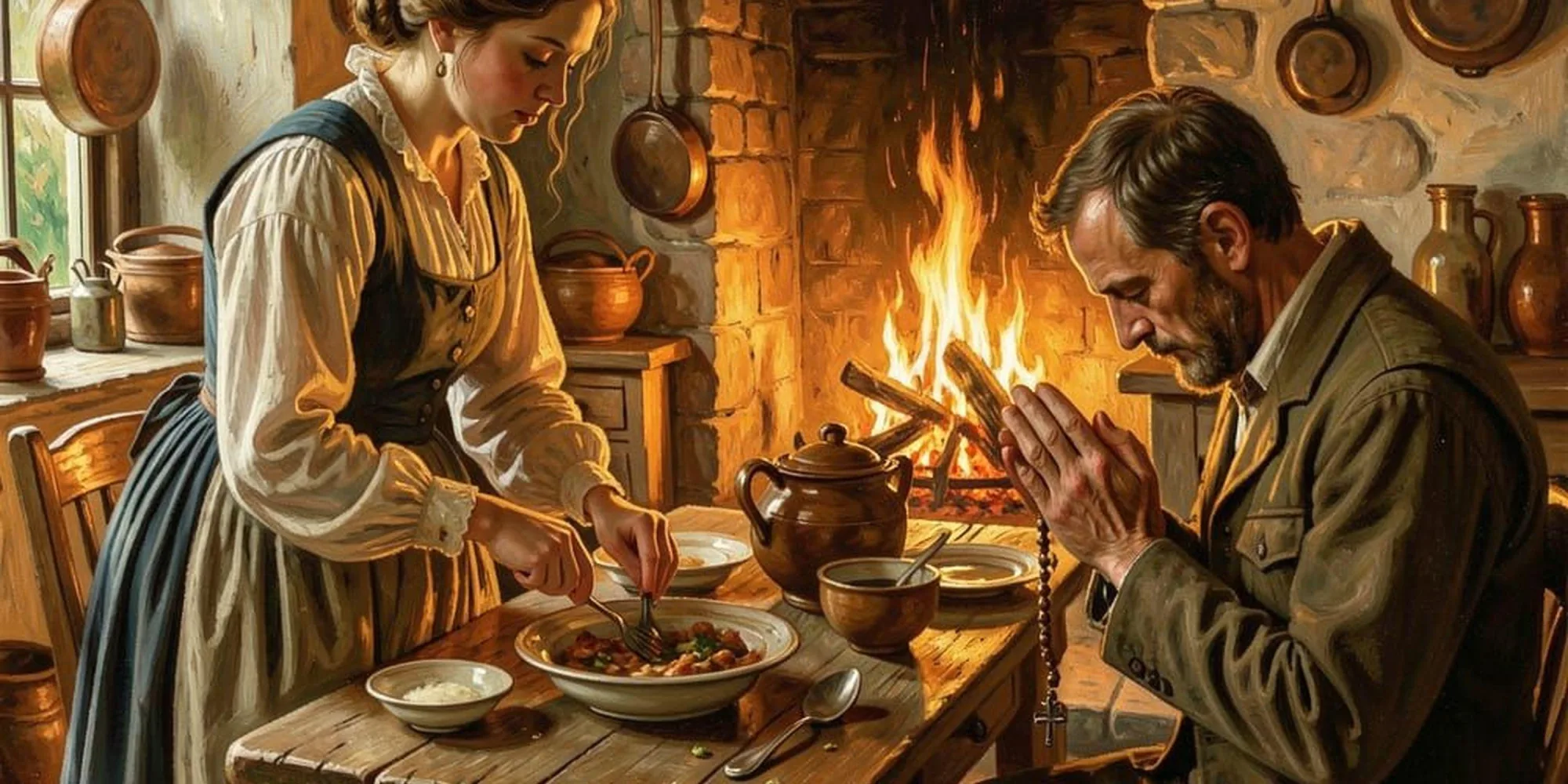
The artwork shows the inside of a warm rural cottage dominated by a large open hearth. Firelight fills the room with gold and amber tones, reflecting across timber beams, stonework, copper pans, crockery and a rough wooden table. Mary stands at the table preparing or serving food, while her husband sits nearby with head lowered and hands clasped around prayer beads. The image captures the intimate domestic world at the centre of the song: food, prayer, firelight, hardship and moral tension held within a small home.
SONG MESSAGE
True strength is often quiet. History remembers men who fought, smuggled, rebelled or defied authority, but families are often held together by those who stayed home, raised children, kept faith and carried the emotional cost. Holdin' Fast argues that courage is not always public or dramatic. Sometimes courage is found in feeding a family, saying a prayer, drawing a boundary and refusing to let darkness fully enter the home.
SONGWRITER NOTES
Holdin' Fast was written from my interest in Irish history, family inheritance and the lives that sit behind the more dramatic stories of rebellion, crime, transportation and survival. As a Tasmanian songwriter descended from John Bresnehan of Limerick, I am naturally drawn to the human reality behind Irish hardship and transportation to Van Diemen’s Land. It is easy to focus on the men who were arrested, sentenced or transported. This song looks instead at the people standing beside them, especially the women whose lives were shaped by decisions they often did not make.
The narrator became clear to me very quickly. She is not weak, sentimental or passive. She is exhausted, faithful and morally awake. She loves the men in her life, but she is not blind to what they are doing. She understands poverty and pressure, yet she also knows that every whispered deed brings something dangerous back into the home. Her line about not having sin crossing the cottage floor is, to me, the spine of the song. It is a domestic line, but it carries enormous spiritual force.
At its heart, Holdin' Fast is a song about endurance under pressure. It is about a woman trying to preserve faith, family and conscience while history presses against the door. The men may create the visible drama, but she carries the deeper burden. She is the one holding fast.