
Listen> https://youtu.be/PNZj6txT1cg?si=SDPdJ4n5z8eE4Vh-
Shine Light On the Poor
She walked the narrow streets,
A quiet figure in the heat,
Holding hands the world forgot,
Turning mercy into something concrete.
Her footsteps found the places
Most hearts never see,
And every day she answered
Need with simple dignity.
She would shine light on the poor,
Where the shadows gathered more,
In the alleys of the broken
She opened up a door.
She would shine light on the poor,
Where the hurting lay unsure,
And love became a lantern
That warmed the world once more.
She left her distant homeland,
A young girl with a calling strong,
And in the dust of Calcutta
She learned where she belonged.
No spotlight made her falter,
No burden made her bend,
She carried hope in both her hands
From morning to day’s end.
She would shine light on the poor,
Where the shadows gathered more,
In the alleys of the broken
She opened up a door.
She would shine light on the poor,
Where the hurting lay unsure,
And love became a lantern
That warmed the world once more.
One life at a time,
One wound she tried to heal,
No grand or sudden miracle —
Just compassion made real.
And in her quiet labour
A greater truth endured:
God’s light can find a pathway
Where hearts have been obscured.
She would shine light on the poor,
Where the shadows gathered more,
In the alleys of the broken
She opened up a door.
She would shine light on the poor,
Where the hurting lay unsure,
And love became a lantern
That warmed the world once more.
Her legacy is simple,
Yet stronger than before —
A small woman with a mighty grace
Who chose to shine light on the poor.
STORY BOARD
SONG OVERVIEW
Written and produced by Tasmanian Songwriter Jason Bresnehan, Shine Light On the Poor is a musical arrangement in the adult contemporary/pop genre leaning toward 1980s and early 1990s keyboard-driven power ballad featuring a female vocal. Inspired by the life of Teresa of Calcutta, the song reflects the era in which Mother Teresa became one of the most recognised humanitarian figures in the world. While millions knew her through television, newspapers and current affairs programs, the song deliberately focuses on the work behind the public attention: a life spent serving poor, sick and abandoned people in the streets of Kolkata.
Within the Saints and Sinners project, Teresa's saintly movement is unique because she became globally recognised during her lifetime. Long before canonisation, many people already viewed her as a living saint. The song explores the relationship between service, visibility and responsibility. Teresa did not seek attention for its own sake, but she understood that public attention could be used to bring visibility to people the world often ignored.
SHINING LIGHT ON THE POOR
The central phrase of the song operates on several levels simultaneously.
At the most practical level, Teresa shone a light on people living in conditions most of the world preferred not to see. Through her work, the poor, dying and abandoned became visible. Their needs became impossible to ignore.
At a spiritual level, the light represents God's love expressed through practical action. The song repeatedly returns to the idea that compassion is not simply a feeling. Compassion becomes visible when it is put into practice.
The phrase also reflects the public visibility that surrounded Teresa throughout much of her life. Through interviews, documentaries, news reports and public appearances, she became a global symbol of humanitarian care. The spotlight that followed her was never the objective, but she used that attention to draw focus back to those who needed help most.
A LIFE OF PRACTICAL COMPASSION
One of the most striking features of Teresa's life is the simplicity of her approach. She did not attempt to solve every problem. Instead, she focused on the person directly in front of her.
The song reflects this through the bridge:
"One life at a time,
One wound she tried to heal."
The lyric captures the practical nature of her work. Her legacy was not built through grand gestures. It was built through thousands of individual acts of care repeated over decades.
This emphasis on practical compassion helps explain why Teresa continues to resonate with people across cultures and generations. The song presents service not as an abstract idea but as a lived reality.
FAME AND PURPOSE
Most people who heard of Mother Teresa first encountered her through media coverage. She was regularly interviewed, photographed and discussed throughout the 1970s, 1980s and 1990s.
The song acknowledges that reality while drawing an important distinction. The media spotlight was not the source of her significance. The source was the work itself.
Teresa became newsworthy because she consistently chose to live among those whom others often overlooked. The spotlight followed the mission, not the other way around.
This theme runs quietly beneath the lyrics. The song recognises that visibility can be useful when it is directed towards a worthy purpose. Teresa used public attention to increase awareness of poverty, suffering and human dignity.
A LEGACY THAT CONTINUES
The closing section of the song focuses on legacy rather than achievement.
Many public figures fade from memory after their deaths. Teresa's influence has continued because it was built upon service rather than personality. The institutions she founded continue operating throughout the world and her example continues to inspire people well beyond the Catholic Church.
The final lyric:
"A small woman with a mighty grace
Who chose to shine light on the poor."
captures the simplicity of her legacy. The song argues that the most significant achievements are sometimes measured not by power, wealth or status, but by the number of lives touched through compassion.
THE ARTWORK
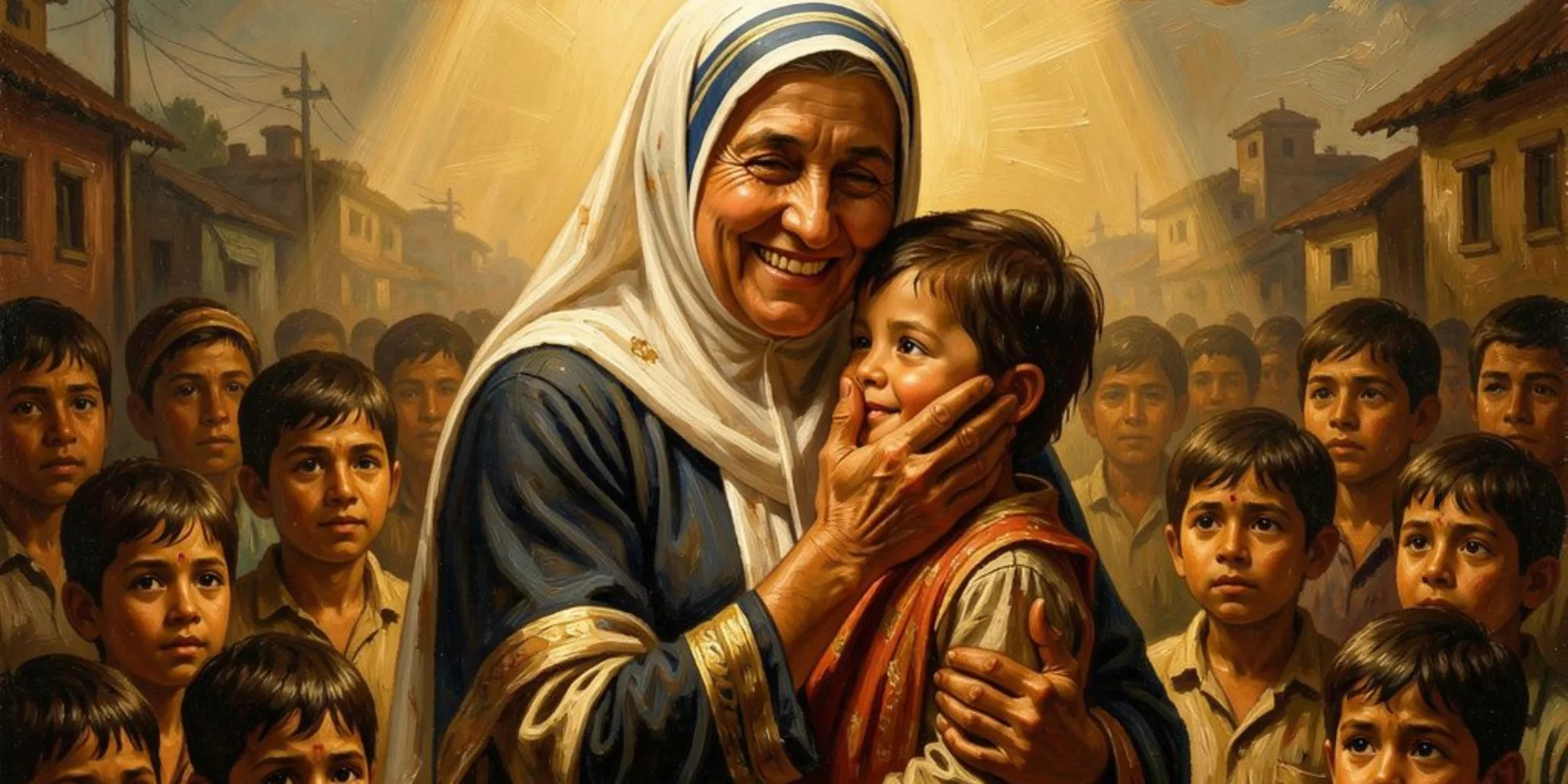
The artwork presents Teresa of Calcutta surrounded by children beneath a powerful beam of light descending from the sky. Positioned in the centre of the composition, she is shown embracing a child while others gather around her. The expression of care and protection immediately communicates the central theme of her life's work.
The light is the defining feature of the image. On one level it represents God's presence and guidance. On another level it resembles a theatre spotlight shining onto a stage. This dual symbolism reflects one of the most unusual aspects of Teresa's life. She became one of the most recognised religious figures of the twentieth century, not because she sought attention, but because the world became fascinated by her work among the poor.
The surrounding children reinforce the focus of her mission. The image deliberately places Teresa within a community rather than isolating her as a heroic figure. The attention remains centred on those she served. The spotlight exists not to elevate Teresa herself but to illuminate the people around her.
The warm colours, golden light and crowded street setting create an atmosphere of hope amidst difficult circumstances. The overall composition perfectly reflects the song's central message: compassion brings light into places often overlooked by the rest of the world.
PERSONAL CONNECTION TO JASON BRESNEHAN SONGWRITER AND PRODUCER
Teresa of Calcutta occupies a unique place within the Saints and Sinners project because she was a contemporary figure during Jason Bresnehan's lifetime. Unlike many saints whose stories belong to distant centuries, Teresa was regularly visible through television, newspapers and current affairs programs throughout the 1980s and 1990s.
For Jason, this means her story feels immediate rather than historical. She represents a living example of how faith can be expressed through practical action in the modern world. The widespread media attention she received also demonstrated that stories of compassion could still capture global attention in an era often dominated by conflict, politics and celebrity culture.
The song resonates with Jason's belief that purpose is ultimately measured by service. Teresa's life demonstrated that influence does not require wealth, status or power. Her influence emerged through consistency, compassion and a relentless commitment to helping those in need.
Shine Light On the Poor therefore becomes more than a song about a saint. It becomes a reflection on how one individual can use both faith and visibility to direct attention toward people who would otherwise remain unseen. The song recognises a woman who used the spotlight not for herself, but to illuminate the lives of others.