
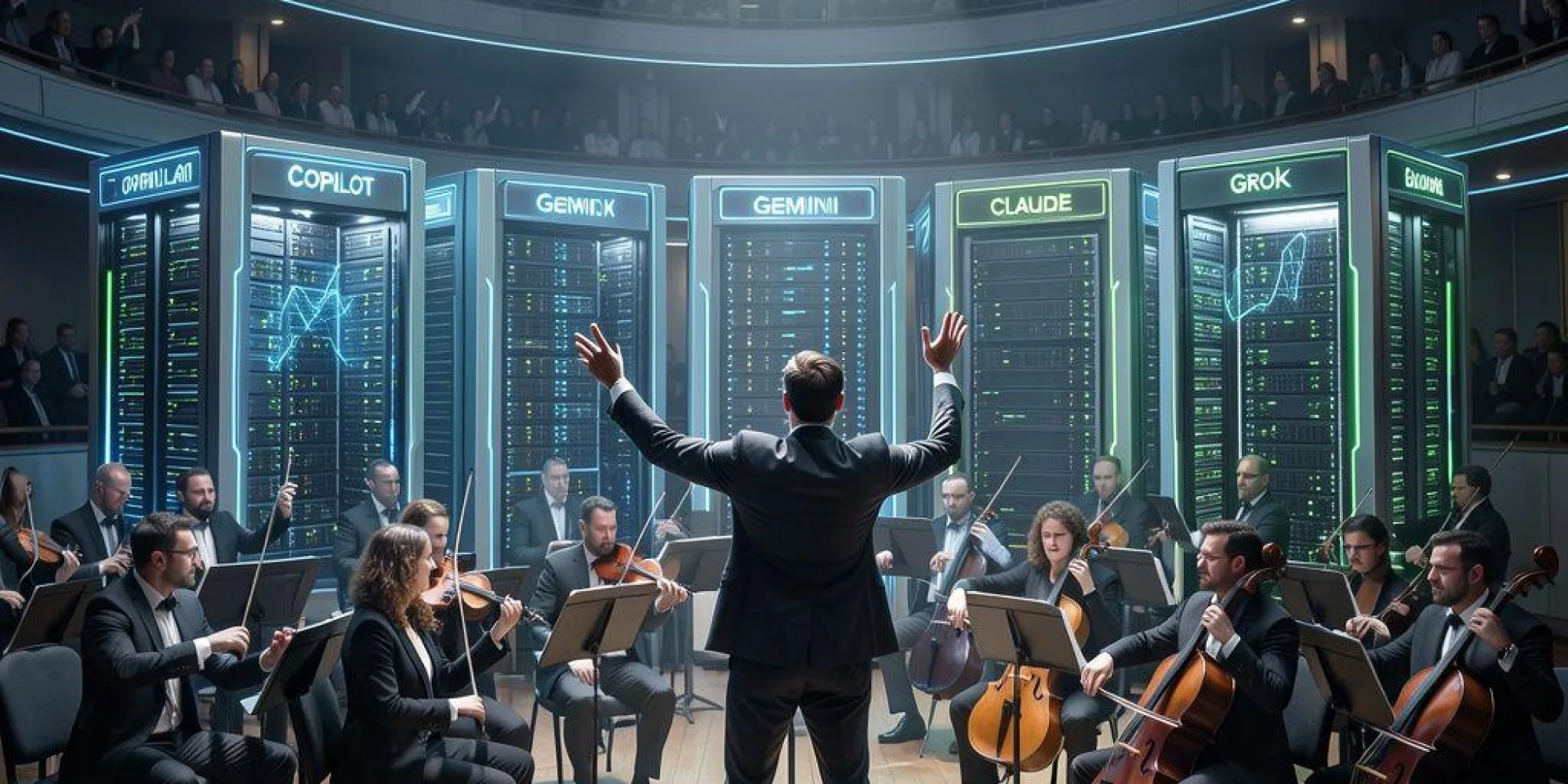
SYSTEMS CONDUCTOR
CONTROLS MULTI‑SYSTEM INTERACTION AND FLOW
An orchestra produces music because each musician plays at the right time, in the correct sequence, and in alignment with every other instrument. The violinist does not follow the flutist, and the percussionist does not follow the cello. They follow the conductor. The conductor does not play the instruments. They control when each part enters, when it holds, when it softens, and when it stops. Without coordination, the same musicians produce noise. With coordination, they produce music.
The Systems Conductor performs the same role inside an AI‑enabled environment. They do not execute systems. They control how systems interact, when they engage, and how they move together. Multiple systems, each operating independently, must combine into a single, coherent outcome rather than competing, overlapping, or drifting apart. The work is not execution. The work is control of interaction, timing, and boundaries.
A system is not defined by its size. It is defined by its structure. A system takes inputs, applies logic, and produces outputs that contribute to an outcome. Some systems are small. Some operate at a global scale. The definition does not change. What matters is whether the system is information‑centric and whether it contains a high degree of human interaction. If those conditions are not met, there is no problem of orchestration. Highly repetitive, low‑information tasks are executed, not conducted. The Systems Conductor operates only where systems are shaped by information and by human interaction with that information.
One of the most obvious environments where multiple systems operate in a coordinated way is an airport. Airline‑controlled and managed systems interact with security systems, check‑in systems, boarding and gate control systems, baggage handling systems, aircraft and crew allocation systems, and air traffic and routing systems. Each of these systems is information‑centric and heavily dependent on human interaction. Passengers, staff, controllers, and crew are constantly providing inputs, receiving outputs, and making decisions. The systems operate independently, each with its own rules and cadence, but they must also connect cleanly and remain aligned, so the passenger experiences a single, coherent journey.
That structure is not unique to airports. It exists in any real operating environment. There is never one system. There are many systems moving at once, each with its own logic and purpose. Most operators can handle a single system cleanly, but when several systems are active simultaneously, they collapse those systems into a single indistinct process and lose control of how information moves between them. Outputs begin to flow in the wrong direction, timing drifts, dependencies break, and systems begin to interfere with each other. Nothing appears obviously broken at first, but the overall operation fragments.
The Systems Conductor prevents this fragmentation. They maintain clean boundaries between systems while ensuring all systems remain connected through a single strategic spine. Each system retains its own logic, cadence, and structure, but the interaction between systems is controlled deliberately. Systems remain separate where separation is required and connected where connection creates value. Blurring systems creates confusion, and over-isolating systems creates disconnection. The discipline lies in controlling the interfaces.
This is where most systems fail. They do not fail internally; they fail at the boundary. Information enters the wrong system, arrives too early, arrives too late, or arrives in a form that corrupts downstream processes. This is cross contamination. A correct output from one system becomes a problem when it is injected incorrectly into another. The Systems Conductor ensures that systems can operate simultaneously without cross contamination, maintaining flow without allowing interference.
In active environments, several systems are always running. A client interaction stream is generating inputs, a document production system is producing outputs, a compliance framework is enforcing structure, and a review cycle is evaluating performance. Each system operates at a different speed, with different levels of human interaction and different decision points. None of them can be allowed to drift or collide. The Systems Conductor ensures that each system contributes to the outcome without undermining the others.
The role is not to reduce the number of systems. The role is to control them. The Systems Conductor determines when a system becomes active, when it hands over to another system, and when it must stop. Systems may operate concurrently, but they do not operate blindly. Flow is controlled without forcing everything into a rigid sequence. Multiple systems can move at once, but they move with coordination.
Managing a multi-system flow requires the ability to see multiple systems clearly at the same time without collapsing them into one. Each system remains distinct, while the operator controls how they interact. This is not a technical capability. It is a cognitive discipline based on clarity, pattern recognition, and strict control of boundaries and flow. The operator must hold separation and connection simultaneously without losing either.
Systems fail when timing is unmanaged. A correct output delivered too early disrupts downstream work. A correct output delivered too late creates delay and bottlenecks. A system that runs faster than its dependencies creates instability, while one that lags slows everything else. The Systems Conductor controls tempo so that systems move together rather than at competing speeds, ensuring that interaction happens when it should, not simply when it can.
As AI expands capability, more systems can run at once and at higher speed. More outputs are generated, more decisions are made, and more interactions occur across system boundaries. Without control, this creates overlap, duplication, and fragmentation. Systems begin to collide, and increased capability produces reduced coherence. The Systems Conductor ensures that increased capability results in coordinated performance rather than unmanaged activity.
The function of the Systems Conductor is consistent across all environments. They maintain clean boundaries, control interaction points, manage timing, prevent cross contamination, and ensure alignment to a single strategic spine. When these elements are in place, multiple systems behave as one coherent operation. When they are not, the same systems create noise.
The Systems Conductor does not manage tasks or isolated workflows. They control how multiple systems combine, so that the final outcome remains clear, aligned, and operationally usable as a single system.
On Amazon, you can purchase my books:
The AI Orchestration Engineer — Jason Bresnehan
A Catholic Gospel Journey Through the Lens of Alcohol Recovery — Jason Bresnehan