
Listen on YouTube Music > https://youtu.be/dz9fUT1sydA?si=6vXIo6ys2Z_roXnM
We Lift Your Name
In a world where stillness reigns, we gather close to hear the call
Holy God, we praise thy name, lifting hearts and voices all
Holy God, we praise thy name!
Lord of all, we bow before thee!
All on Earth thy sceptre claim,
All in Heaven above adore thee;
Infinite thy vast domain,
Everlasting is thy reign.
In the stillness of the night, we find our way,
Singing praises to the light, guiding every day.
Holy, holy, Lord we sing, hearts fully engaged,
In the warmth of your embrace, we lift your name.
Hark! the loud celestial hymn,
Angel choirs above are raising!
Cherubim and seraphim,
In unceasing chorus praising,
Fill the heavens with sweet accord;
Holy, holy, holy, Lord!
Every note, a prayer to thee, reaching to the skies,
With every breath, we feel the peace, a love that never dies.
In the stillness of the night, we find our way,
Singing praises to the light, guiding every day.
Holy, holy, Lord we sing, hearts fully engaged,
In the warmth of your embrace, we lift your name.
Lo! the apostolic train
Join thy sacred name to hallow!
Prophets swell the loud refrain,
And the white-robed martyrs follow,
And from morn to set of sun,
Through the Church the song goes on.
In the stillness of the night, we find our way,
Singing praises to the light, guiding every day.
Holy, holy, Lord we sing, hearts fully engaged,
In the warmth of your embrace, we lift your name.
Holy Father, holy Son,
Holy Spirit, Three we name thee,
Though in essence only one,
Undivided God we claim thee;
And adoring bend the knee,
While we own the mystery.
In our hearts, you lead the way, guiding through the storm,
Spare thy people, Lord, we pray, keep our spirits warm.
In the stillness of the night, we find our way,
Singing praises to the light, guiding every day.
Holy, holy, Lord we sing, hearts fully engaged,
In the warmth of your embrace, we lift your name.
Thou art King of glory, Christ!
For us sinners sacrificed,
First to break the bars of death,
And with faith, we breathe our breath.
In the echoes of this song, let our hearts stay strong,
Come again, we wait for thee, guiding all who long.
STORY BOARD
SONG OVERVIEW
Written and produced by Tasmanian Songwriter Jason Bresnehan, We Lift Your Name is a Contemporary Christian Music (CCM) soft rock song built around one of Christianity's oldest and most enduring themes: the unbroken praise of God across Heaven and Earth. Drawing from ancient Christian hymnody, scripture, worship traditions and the imagery of heavenly praise, the song creates a bridge between timeless faith and modern worship expression.
The foundation of the song comes from the historic Christian hymn Holy God, We Praise Thy Name, itself influenced by the ancient Te Deum. Throughout the song, heavenly choirs, angels, apostles, prophets, martyrs and ordinary believers are united in a single act of worship. The result is a powerful picture of the Church not merely as a modern gathering but as part of a worshipping community stretching across centuries and eternity.
The repeated refrain "we lift your name" becomes both personal and communal. It expresses individual devotion whilst simultaneously connecting the worshipper to the broader body of believers who have sung similar praises throughout Christian history.
At its heart, We Lift Your Name is a song about joining an eternal song that began long before us and will continue long after us.
THE SCENE
The song unfolds across two interconnected settings.
The first is the quiet intimacy of personal worship. The recurring references to stillness, night, prayer and reflection create the image of an individual believer drawing close to God in silence and reverence. The atmosphere is peaceful, contemplative and deeply personal.
The second setting expands dramatically into the heavenly realm described throughout scripture and Christian tradition. Angelic choirs fill the heavens with praise. Apostles, prophets, martyrs and saints join the worship. The boundaries between Earth and Heaven begin to dissolve as one vast chorus emerges.
These two scenes are never separate. The song continually moves between the individual believer and the worshipping universe, reinforcing the idea that private worship participates in something infinitely larger than itself.
The result is both intimate and majestic.
THE NARRATOR
The narrator serves as both worshipper and guide. The voice invites listeners into praise rather than merely describing it. Unlike a storyteller recounting events, the narrator actively participates in the worship taking place throughout the song.
The narrator is conscious of standing within a long tradition of Christian faith. References to angels, apostles, prophets and martyrs create a sense of continuity that stretches across centuries of belief.
At the same time, the voice remains accessible and personal. The worship described is not reserved for saints, theologians or church leaders. It belongs to ordinary believers seeking God in the midst of everyday life.
This balance between personal devotion and collective worship gives the song much of its emotional power.
PURPOSE
The purpose of We Lift Your Name is to encourage worshippers to recognise that praise is not merely an individual act but a participation in something eternal.
Many Christians experience worship primarily through local churches, congregations and personal prayer. The song expands that perspective by presenting worship as part of a much larger reality. The believer's voice joins angelic voices, historical voices and future voices in honouring God.
The song therefore seeks to create both humility and encouragement. Humility because human worship is part of something far greater than ourselves. Encouragement because no believer worships alone.
Ultimately, the song celebrates the universal and timeless nature of Christian praise.
IDENTITY
Identity within We Lift Your Name is grounded in belonging to God. The song repeatedly reminds worshippers that they are part of a spiritual family extending beyond geography, nationality, denomination or historical period.
The references to apostles, prophets, martyrs and the Church emphasise continuity. The modern believer is connected to countless others who have shared the same faith, prayers and hopes throughout history.
Identity is therefore not based on personal achievement or status. It is rooted in participation in God's story.
The song suggests that worship itself becomes an expression of identity, revealing who we are through the One we honour.
MOVEMENT
Movement within the song occurs through an expanding circle of worship. It begins with personal prayer and gradually widens to encompass the Church, the saints and ultimately Heaven itself.
Each verse broadens the listener's perspective. Individual devotion becomes congregational worship. Congregational worship becomes heavenly worship. Heavenly worship becomes eternal worship.
The final sections bring the focus back to Christ, connecting praise to salvation, resurrection and future hope. The movement therefore follows the trajectory of the Christian story itself: creation, worship, redemption and anticipation of Christ's return.
This continual expansion gives the song a sense of growing scale and significance.
MUSICAL DIRECTION
We Lift Your Name sits firmly within Contemporary Christian Music and is best described as CCM soft rock, with a very deliberate emphasis on the word soft. Unlike arena-style worship music that relies upon escalating intensity and dramatic dynamics, this song draws much of its strength from warmth, restraint and reverence.
The arrangement is centred around piano, gentle rhythm instruments, layered vocal harmonies and tasteful contemporary production. The music supports the lyric rather than competing with it. Even when the song reaches its larger moments, there remains a sense of calm and devotion rather than spectacle.
There are strong influences from inspirational Christian music, soft rock and modern worship, but the emotional experience feels closer to reflection than celebration. The listener is invited to participate rather than be overwhelmed. The melody flows naturally, the vocal remains warm and expressive, and the entire arrangement creates space for contemplation.
What makes the musical direction particularly effective is the contrast between the enormous scale of the lyric and the gentleness of the arrangement. The song speaks of angels, heavenly choirs, apostles, martyrs, the Trinity and the eternal reign of God, yet delivers those themes through softness rather than grandeur. The result is deeply worshipful, accessible and emotionally engaging.
SCRIPTURAL CONNECTION
Although the song draws heavily from the historic hymn Holy God, We Praise Thy Name, its imagery echoes several powerful biblical passages.
The references to angelic worship strongly connect with Isaiah's vision of Heaven, where seraphim continually proclaim, "Holy, holy, holy is the Lord Almighty." Similar imagery appears in Revelation, where heavenly beings endlessly worship before the throne of God.
The imagery of all creation praising God recalls numerous Psalms, particularly those celebrating God's kingship and eternal reign. The declarations that Heaven and Earth worship together closely reflect the biblical vision of all creation recognising God's sovereignty.
The song's references to apostles, prophets, martyrs and the Church also mirror New Testament imagery of the communion of believers joined together across time and eternity through Christ.
Rather than focusing on a single passage, the song weaves together themes that run throughout scripture.
WHY THIS SONG?
The inspiration behind We Lift Your Name appears to emerge from the enduring power of Christian worship across centuries. Whilst styles, languages and instruments may change, the central act of praising God remains unchanged.
The song captures that continuity by blending ancient hymn lyrics with contemporary worship language. In doing so, it demonstrates that modern believers participate in the same acts of worship that inspired previous generations.
The result is a song that feels both ancient and modern at the same time.
It honours tradition whilst remaining accessible to contemporary audiences.
WORSHIP AND COMMUNITY
One of the strongest themes within We Lift Your Name is the communal nature of worship. Although personal prayer is important, the song continually draws attention towards collective praise.
The individual voice becomes part of a larger chorus. Local congregations become part of the global Church. The global Church joins the worship unfolding in Heaven itself.
This movement reinforces the idea that worship is fundamentally relational. Believers do not simply worship alone. They worship alongside one another and alongside generations of Christians who have gone before them.
The recurring phrase "we lift your name" captures this beautifully. The emphasis is not I. The emphasis is we.
CONNECTION TO THE SONGWRITER
Like several of Jason Bresnehan's Christian songs, We Lift Your Name reflects a fascination with the continuity of faith across generations. The song is less concerned with individual testimony than with the larger story of Christian worship.
The themes resonate strongly with Jason's Catholic background and his ongoing engagement with scripture, liturgy and Christian tradition. The connection between ancient faith and modern believers appears throughout much of his Christian writing and songwriting.
Rather than focusing on personal experience alone, this song directs attention towards God and towards the worshipping community of believers that spans both history and eternity.
In doing so, it becomes less a personal statement and more an invitation to participate.
THE ARTWORK
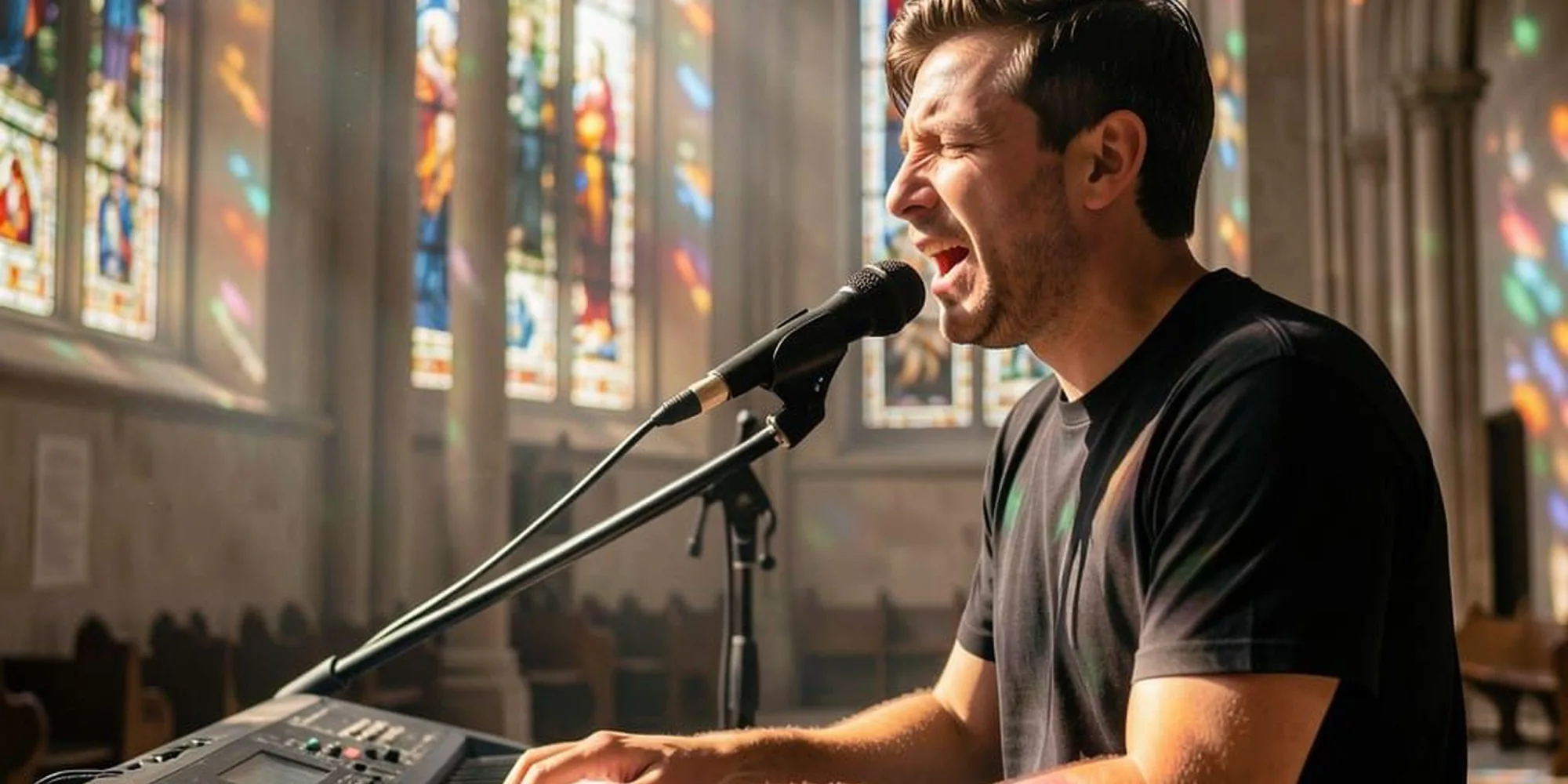
The artwork depicts a musician seated at a keyboard inside a large church illuminated by magnificent stained-glass windows. Coloured light streams through the glass, casting reflections throughout the sanctuary and creating an atmosphere of reverence, beauty and transcendence.
The image works particularly well because it visually connects creativity, worship and sacred space. The musician is not portrayed as a performer entertaining an audience. Instead, the musician appears fully engaged in an act of worship, using music as a vehicle for praise.
The stained glass serves as an important symbolic element. Throughout Christian history, stained-glass windows have been used to tell biblical stories, communicate spiritual truth and direct attention towards God. The coloured light filling the church reinforces the song's themes of divine presence and heavenly worship.
The artwork also reflects the song's blend of old and new. The church architecture and stained glass connect to centuries of Christian tradition, whilst the modern keyboard represents contemporary Christian music. Together they mirror the song itself, which combines historic Christian praise with modern CCM expression.
The image is particularly effective because it captures the softness at the heart of the song. This is not a stadium concert. There is no crowd, no spectacle and no performance-driven atmosphere. Instead, there is one musician, one instrument and one act of worship. The image reflects the contemplative, reverent and gentle nature of the music itself.
SONG MESSAGE
The message of We Lift Your Name is that worship is far bigger than any individual believer, congregation or generation. Every act of praise participates in a much larger reality that stretches throughout Christian history and into eternity.
The song reminds listeners that they are not isolated worshippers. They stand within a lineage of faith that includes apostles, prophets, saints, martyrs and ordinary believers who have all lifted their voices to God. Beyond that, they join the worship taking place in Heaven itself.
The song also emphasises God's kingship, holiness and faithfulness. Worship is presented not as obligation but as a natural response to God's greatness and love.
Ultimately, We Lift Your Name is an invitation to see worship from a larger perspective. Every prayer, every hymn and every song becomes part of an eternal chorus proclaiming the glory of God.
SONGWRITER NOTES
When listening to We Lift Your Name, what strikes me most is its connection to some of Christianity's oldest worship traditions. The lyrics clearly draw from the historic hymn Holy God, We Praise Thy Name, which itself traces its heritage to the ancient Te Deum.
As I explored the song, I was reminded of several scriptural passages that seem to sit beneath the imagery. The visions of heavenly worship found in Isaiah and Revelation immediately come to mind, particularly the repeated declarations of "Holy, holy, holy." The song also echoes the Psalms, where all creation is called to praise God and acknowledge His eternal reign.
What makes the song particularly beautiful is the contrast between the scale of the lyric and the gentleness of the music. The song speaks about Heaven, angels, apostles, martyrs, saints and the eternal reign of God, yet it never feels overwhelming. Instead, it invites the listener quietly into worship.
The artwork reinforces this beautifully. A modern musician sits beneath ancient stained glass, creating a visual representation of the same idea found throughout the song. The methods may change. The instruments may change. The generations may change.
The worship remains.
That is the enduring power of We Lift Your Name. It reminds us that every believer who lifts their voice in praise becomes part of a song that has been echoing through history and will continue long after we are gone. It is reverent without becoming distant, theological without becoming academic, and worshipful without relying on spectacle.
Like the best Christian music, it does not draw attention towards the singer.
It quietly lifts attention towards God.